Why Only 12% Become AI Leaders
The AI divide is not about access to tools. It is about whether AI has entered production workflows, governance, and business measurement.
Why Only 12% Become AI Leaders

There is a moment many CEOs now recognize. The company has bought AI tools. Employees are using them. Sales teams draft emails faster. Marketing produces more copy. Product managers test more ideas. Finance people ask models to clean up spreadsheets. The mood inside the company feels modern.
Then the monthly review arrives. Cycle time has not moved much. Exceptions still pile up. The same customers wait for the same approvals. Managers cannot point to one part of the P&L and say, with confidence, “AI changed this.”
That is the gap. AI adoption is spreading quickly. AI value is not.
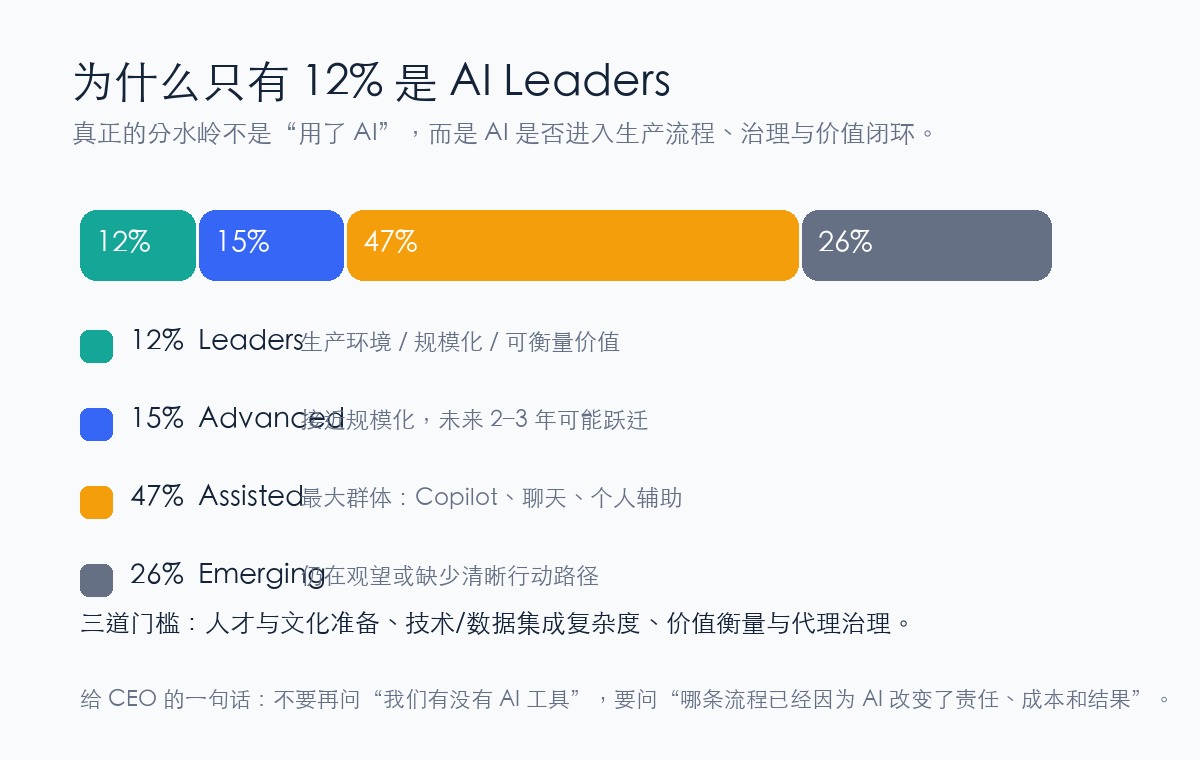
Genpact’s 2026 Autonomy by Design: Scaling AI for Enterprise Value research, based on more than 500 senior executives from companies with $1 billion to more than $50 billion in revenue, divides companies into four maturity groups: 12% leaders, 15% advanced, 47% assisted, and 26% emerging. The useful part of that framework is not the label. It is the definition of leadership.
AI leaders are not the companies with the loudest demos or the most licenses. They are the companies that have moved AI into production workflows, scaled it beyond isolated use cases, and built a way to measure business outcomes. In plain language: AI has left the employee’s desktop and entered the company’s operating model.
Tools are not the transformation
A purchasing manager may spend the day moving across supplier emails, purchase orders, inventory screens, contract terms, invoice exceptions, and approvals. A chatbot that summarizes messages is helpful. It saves time. But it does not redesign procurement.
The real value appears when AI understands the flow of work: which data source is trusted, which exception needs escalation, which supplier should be asked for missing information, which action can be taken automatically, and which decision must remain with a person. That is process intelligence. It is not a slide. It is the organization’s working knowledge of how work actually gets done.
Most companies do not fail because they lack enthusiasm. They fail because they distribute AI horizontally and never rebuild work vertically. Everyone gets a small productivity boost. The system does not change. People write better emails, prettier decks, and cleaner summaries, while the cost base, customer wait time, working capital, or error rate remains mostly untouched.
The assisted majority can fool itself
The largest group in Genpact’s framework is the assisted category, at 47%. These companies are not asleep. They use copilots, meeting summaries, knowledge assistants, coding tools, customer-service drafts, and content-generation systems.
The problem is that most of this work remains personal productivity. It helps the individual complete a task. It does not necessarily make the company more efficient.
This stage is dangerous because it feels like progress. There are internal trainings, tool rollouts, executive updates, and department demos. But three questions often expose the gap: which workflow has been rewritten, which operating metric has improved for several months, and who owns the result when AI touches the process?
If the company cannot answer those questions, it is using AI. It is not yet operating with AI.
The frozen middle is not lazy. It is overloaded.
In 2026, many boards and CEOs no longer need to be convinced that AI matters. Senior leaders talk about it, fund it, and increasingly try the tools themselves. Younger employees often adopt AI naturally because it already sits inside their daily habits.
The harder layer is the middle of the organization.
Middle managers carry the operational burden. They own delivery, staffing, complaints, handoffs, metrics, escalations, and the weekly mess that never appears in strategy documents. When AI lands on their desk, it often arrives not as freedom but as risk. If the system gives the wrong answer, who is accountable? If an employee feeds sensitive data into the wrong tool, who deals with it? If a workflow change disrupts a customer, who takes the call?
That is why AI often gets reduced to safe pilots. Pilots are presentable. They are controllable. They are easy to discuss in a steering committee. They rarely change the business.
The middle layer needs a different kind of training. Not prompt tricks. Not tool tours. Managers need to learn how to identify repetitive work, define acceptable outputs, set approval boundaries, review exceptions, and connect AI work to operating metrics. They need to move from senior executors to owners of workflow outcomes.
The next risk is not using AI. It is not knowing where AI is working.
As companies move from assistants to agents, the risk changes. The old problem was employees pasting data into public tools. The next problem is more subtle: departments build agents that connect to internal systems, call APIs, reply to customers, generate quotes, trigger tickets, or monitor exceptions.
Each agent may look useful. Together, they can become a new form of shadow IT.
Executives should be able to answer basic questions. How many agents does the company have? Which systems do they access? Which models and vendors do they use? Who can shut them down? What data did they touch? How much do they cost each day? Who samples their output quality? If one out of 100 agents behaves badly, can the company find it the same day?
Genpact’s research puts agent orchestration and governance near the center of the enterprise AI problem. Its main 2026 report says only 3% of respondent organizations are actively implementing agent orchestration. Its manufacturing analysis, published in April 2026, found that only 6% of manufacturing organizations are AI leaders, 2% are actively implementing agentic orchestration, and 23% report measurable business value from AI applications. Its retail analysis, published in June 2026, points to workflow integration, skill gaps, and fragmented ownership as barriers between experimentation and enterprise-wide impact.
These are not technology footnotes. They are management facts. Without an agent inventory, permission model, cost monitor, data boundary, vendor standard, and rollback process, successful AI adoption can increase the size of the control problem.
Data matters. Integration may be harder.
For years, companies have said the problem is data. That is partly true. Dirty data, fragmented systems, inconsistent master data, and unclear permissions all slow AI down.
But by 2026, another problem has become more visible. Integration may be harder than data.
Large companies are not blank pages. They run on ERP systems, CRM tools, supply-chain platforms, finance systems, legacy databases, outsourced processes, custom applications, email, and spreadsheets. If AI is going to create real value, it cannot sit beside those systems and merely answer questions. It has to read context, trigger action, keep logs, accept approvals, and stop when an exception crosses a boundary.
That is why simple-looking AI ideas become complicated in production. The model is not the hard part by itself. The operating system around the model is the hard part: responsibility, interfaces, approvals, exception handling, security, cost, and auditability.
The CEO’s better questions
The most useful AI questions are not abstract. A CEO can ask them in tomorrow’s management meeting.
- Which three workflows should we change first? Start with work that is frequent, expensive, exception-heavy, or painful for customers.
- What is the baseline? Cost, cycle time, error rate, escalation rate, and customer wait time must be visible before AI enters the process.
- How does the human role change? Does the person approve, judge exceptions, handle edge cases, or still move information by hand?
- Who owns the outcome? If IT, legal, finance, and business units can all wait for each other, the workflow will not change.
- Where are the boundaries? Data, customer communication, spending limits, approvals, and rollback rules need to be defined before scale.
An 80-person company might start with customer support, lead qualification, finance reconciliation, procurement quotes, or content operations. An 8,000-person company might start with accounts payable, claims, supply-chain forecasting, employee service, or contract review. The scale differs. The rule does not: choose high-frequency work with a clear owner and a measurable baseline, then let AI enter that workflow.
Small companies have an opening
AI-native startups and mid-sized firms have one real advantage: less weight. Fewer layers, fewer legacy systems, fewer committees, and lower political cost when a workflow changes. A founder can decide on Monday and test on Tuesday.
That does not mean small companies automatically win. Their common mistake is treating speed as permission for chaos. No data boundary. No customer disclosure. No approval record. No cost monitor. It looks fast until something breaks.
The better small company builds AI as a lightweight operating system from the start: shared accounts, shared knowledge base, clear customer-data rules, reusable workflow templates, cost visibility, and weekly reviews. Do not wait until the company has 300 people to build governance. At that point, governance becomes a repair job.
From adoption to autonomy in practice
Stanford HAI’s 2026 AI Index describes a widening gap between what AI can do and how prepared society and institutions are to manage it. The same gap exists inside companies. Capability, investment, and adoption are moving quickly. Evaluation, governance, and operating discipline are not moving at the same speed.
That is why the 12% number matters. It is not a trophy. It is a warning. AI transformation is not a software purchase, a training campaign, or an innovation contest. It is a redesign of workflow, accountability, governance, and measurement.
Advanced companies may move into the leader group over the next few years. Assisted companies can move too. But only if they stop treating AI as a set of employee tools and start treating it as a work system.
A simple test for the next review meeting
- If AI is not in a production workflow, it is tool adoption.
- If there is no baseline, there is no value proof.
- If there is no workflow owner, there is no scale.
- If middle managers are not trained, the change will not travel through the company.
- If agents are not inventoried and monitored, they become shadow IT.
- If leaders do not use the tools themselves, they will underestimate the speed of change.
- If the company waits for a perfect roadmap, the technology will move before the roadmap is finished.
The companies in the 12% group are not simply better at following the AI market. They are earlier at putting AI into real work, where it has to face real data, real errors, real responsibility, and real metrics.
For everyone else, the opportunity is still open. The first question is not “Do we use AI?” The better question is “Which workflow has AI made faster, safer, cheaper, or more reliable?” The sooner a company can answer that question, the closer it moves to the leader group.
Sources
- Genpact, Autonomy by Design: Scaling AI for Enterprise Value, 2026.
- Genpact, Autonomy by Design: Scaling AI for Enterprise Value in Manufacturing, published April 11, 2026.
- Genpact, Autonomy by Design: Scaling AI in Retail for Enterprise Value, published June 23, 2026.
- Stanford HAI, 2026 AI Index Report.
Comments
0 public responses
All visitors can read comments. Sign in to join the discussion.
Log in to comment