When the API Bill Gets Bigger Than Payroll, Model Choice Becomes a Cost Discipline
Chinese open and open-weight models are not winning because enterprise buyers became sentimental. They are winning because the unit economics changed.
When the API Bill Gets Bigger Than Payroll, Model Choice Becomes a Cost Discipline
Some AI stories do not start with a launch event. They start with a finance spreadsheet.
A company building AI agents will naturally begin with the strongest model it can buy. Read the inbox. Draft replies. Classify tickets. Summarize calls. Run tools. Try again when the first answer is wrong. In the first phase, the question is simple: can this thing work at all?
Then the second spreadsheet arrives: how much did inference cost this month? Is it still growing faster than usage? Is the model bill now larger than a team’s payroll?
That is the part of the story that makes Lindy’s migration matter. Its CEO, Flo Crivello, said inference had become Lindy’s single biggest cost, even exceeding payroll. The company later moved 100% of its traffic from Anthropic’s Claude models to DeepSeek V4. According to Crivello, the move could save millions of dollars within months, while improving performance on several of Lindy’s core use cases, including email triage and drafting replies in a user’s voice.
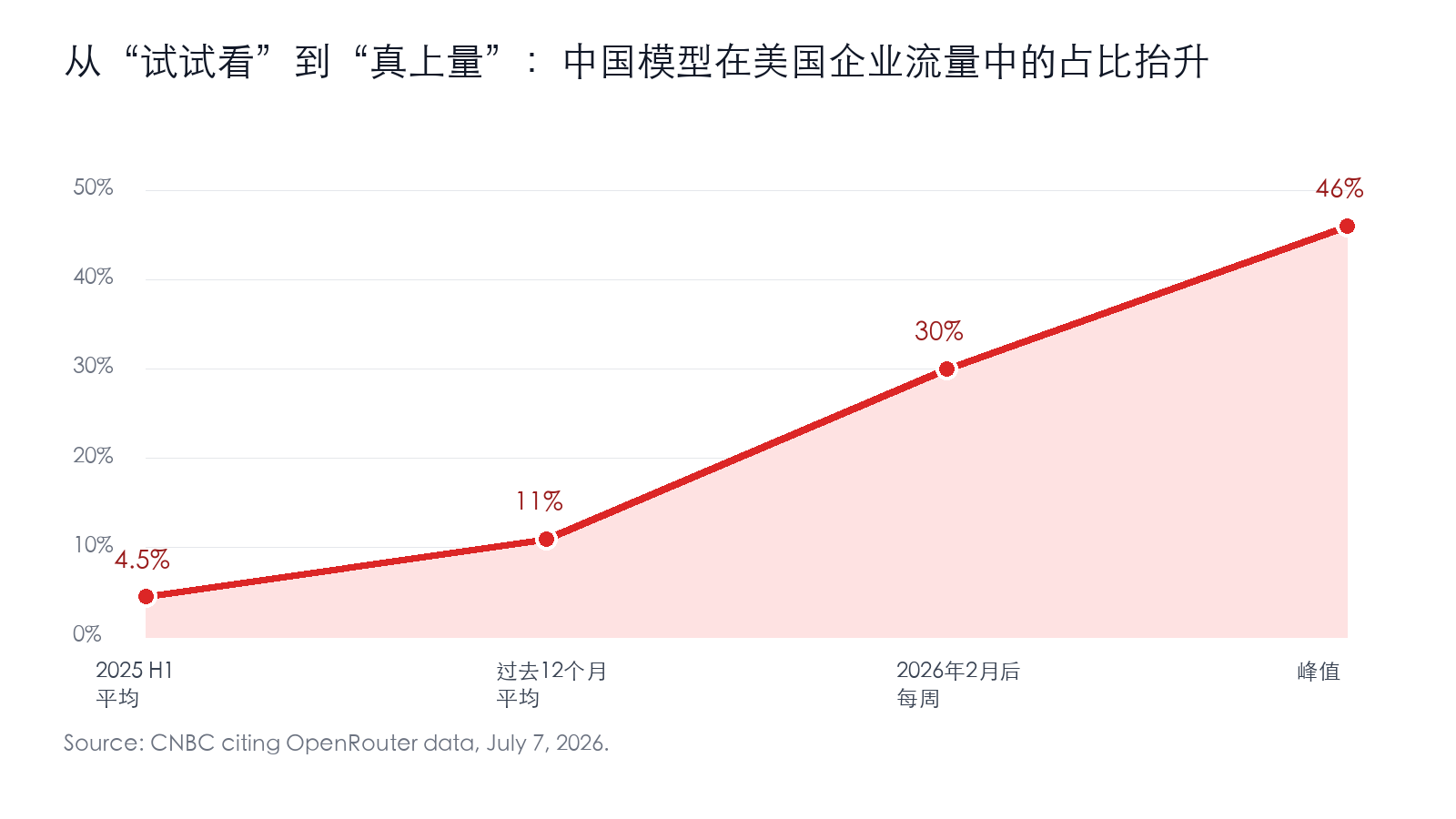
This is not only a Lindy story. CNBC reported on July 7 that U.S. companies’ token usage on Chinese AI models through OpenRouter has stayed above 30% every week since February 8, peaking at 46%. The average over the previous 12 months was 11%; in the first half of 2025, it was only 4.5%. A Chinese report citing interviews with overseas companies including Lindy, Floxy, VINspectorAI, Substance Law, and ExpertEdge said inference costs fell by 30% to 95% after migrating to Chinese large models.
The lesson is not that Claude or OpenAI suddenly stopped being good. They remain strong, especially for difficult reasoning, long-horizon coding, complex agent work, and high-stakes reliability. The lesson is that enterprise buyers no longer ask only, “Which model is best?” They ask a sharper question: Does this task really need the best model, and if a much cheaper model is already good enough, why should every routine request be billed at flagship prices?
Pricing is splitting the model market
OpenAI’s API pricing page lists GPT-5.5 at $5 per million input tokens and $30 per million output tokens for standard short-context use. GPT-5.5 Pro is much higher: $30 input and $180 output. Anthropic’s pricing page lists Claude Sonnet 5 at an introductory $2 input and $10 output through August 31, 2026, then $3 and $15 afterward. Claude Opus 4.8 is listed at $5 input and $25 output.
Chinese models sit in a very different cost band. DeepSeek’s official pricing page lists DeepSeek V4 Flash at $0.14 input and $0.28 output per million tokens, and V4 Pro at $0.435 input and $0.87 output. Alibaba Cloud’s Model Studio lists Qwen3.7 Max in mainland China at RMB 12 input and RMB 36 output per million tokens, with Qwen3.7 Plus at RMB 2 input and RMB 8 output. On OpenRouter, GLM-5.2 is listed at $0.35 input and $1.10 output, and Qwen3.7 Max at $1.25 input and $3.75 output.
That price spread is not a rounding error. It is the difference between a feature that can be rolled out to every employee and a feature that has to be rationed.
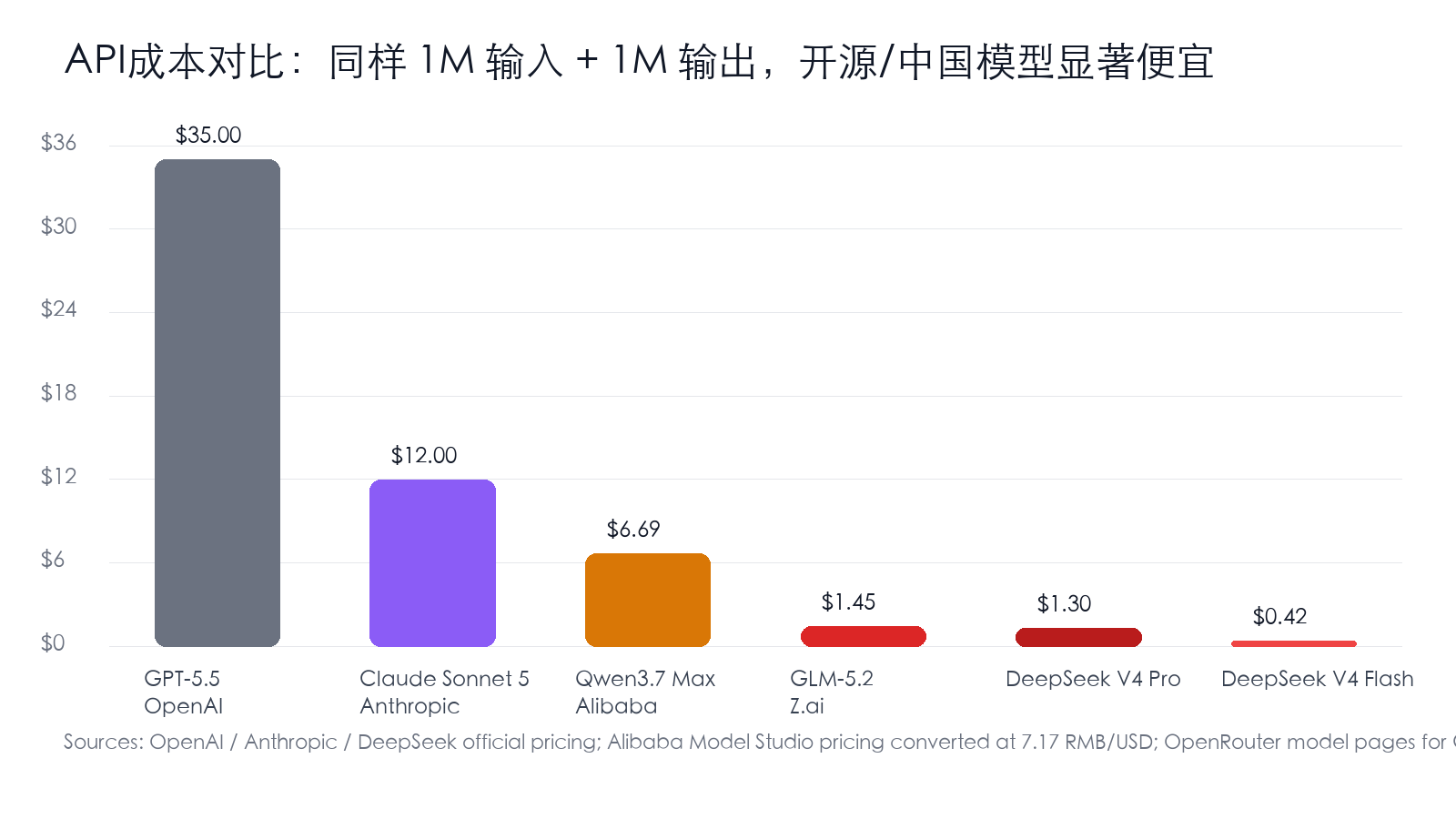
Take a simple blended example: one million input tokens plus one million output tokens. GPT-5.5 is about $35. Claude Sonnet 5 is about $12 at its introductory price. DeepSeek V4 Pro is roughly $1.31. GLM-5.2 is about $1.45. The real bill will depend on caching, batch processing, routing, context length, and negotiated discounts, but the order of magnitude is hard to ignore.
That is why Justin Summerville of OpenRouter told CNBC that open-source Chinese models can be 60% to 90% cheaper than leading Anthropic and OpenAI models. Harpreet Arora of Vercel put the operating logic even more plainly: when a task does not need the best model, teams are beginning to route it to the cheapest one that is good enough, and the recent wave of Chinese models is winning that trade.
The capability gap is not gone. The “good enough” zone is larger.
It would be sloppy to claim that Chinese open or open-weight models beat U.S. proprietary frontier models on every task. Lindy itself said DeepSeek still trails Sonnet on some complex workflow-automation tasks. But that did not prevent DeepSeek from being the better business choice for many of Lindy’s core workloads.
That distinction matters. Enterprises do not buy leaderboard positions. They buy task coverage.
Customer-support summaries, sales lead cleanup, document extraction, internal knowledge-base answers, routine coding assistance, email preprocessing, spreadsheet generation, content rewriting — these workloads run again and again. A small saving per call becomes a large saving by the end of the month. The hardest 5% of tasks can still be routed to Claude, OpenAI, or another premium model. Model routing becomes an architecture, not a hack.
The developer-workflow signal is also getting clearer. Moonshot’s Kimi API documentation now explicitly frames Kimi K2.7 Code for programming-agent scenarios including Codex, Claude Code, Cline, RooCode, OpenCode, and Hermes Agent. That is not just a chatbot positioning. It is a bid to enter the daily tooling layer where developers, agents, and enterprise automation systems actually spend tokens.
Why companies are giving up on “flagship for everyone”
Many companies made the same mistake in the first wave of internal AI adoption: give employees the strongest model, and productivity will follow.
The reality is colder.
An employee can spend tokens all day without creating proportional value. A model can draft an email, summarize a meeting, or produce a code sketch, but if the surrounding workflow is not redesigned, if there is no review path, no system integration, and no measurable output, the result may just be a more expensive version of being busy.
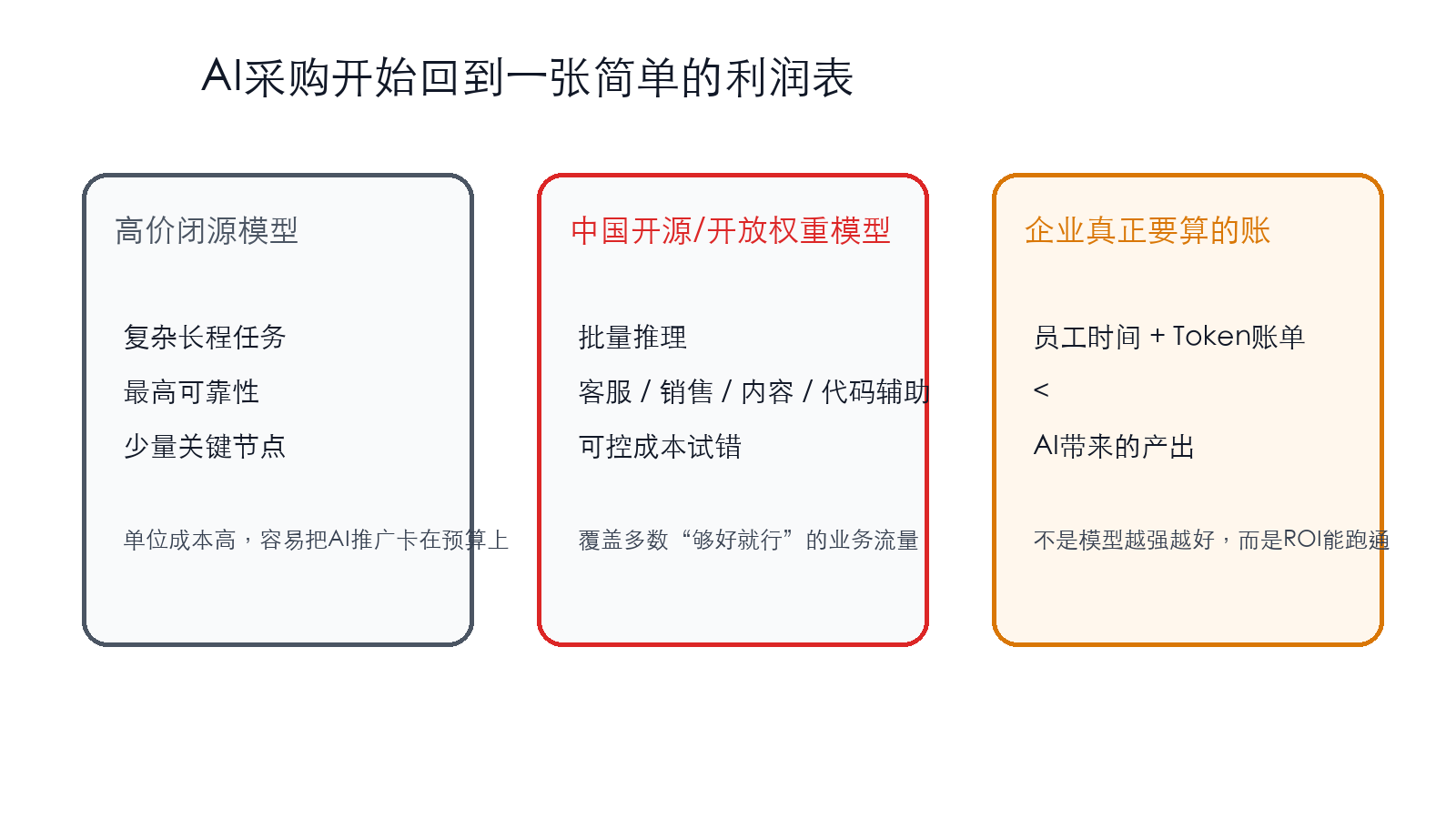
The AI program that survives is the one that can pass a basic inequality:
employee time cost + token cost < the output or savings created by AI
If that inequality fails, even the best model becomes hard to roll out broadly. If it works, a model does not have to be number one on every benchmark to become the default.
Good news for Chinese models, but not an automatic win
This is a genuine opening for Chinese AI models. Not because overseas buyers suddenly changed their politics, but because cost, open weights, API compatibility, private-deployment options, routing flexibility, and cloud price competition now point in the same direction.
The advantage is not only “cheap.” Cheap gets the first meeting. What gets a model into production is a more complete package: capability close enough for many business tasks, OpenAI-compatible APIs, stronger control over the stack, and an ecosystem that can serve agent platforms and developer tools.
Still, this is not a story where every company abandons Claude and OpenAI overnight. High-risk, high-value, complex reasoning and long-horizon agent work will continue to use premium frontier models. The more likely architecture looks like this:
- routine high-volume tasks go to Chinese open or open-weight models;
- difficult and critical tasks go to U.S. proprietary frontier models or a small number of premium alternatives;
- middle-tier models get squeezed because they are neither cheap enough nor clearly best;
- serious companies invest in evaluation, model routing, caching, observability, and cost controls.
That is a healthier market. Models stop winning only by demo videos and benchmark charts. They have to pass the audit of real business usage.
Price is not a low-end argument. It is the scaling argument.
People sometimes hear “cost-performance” and assume it means settling for a lower-quality product. In AI, the opposite is often true. Cost becomes the central question only when a technology starts moving from demos into daily production.
A prototype can ignore unit economics. A team trial can ignore unit economics. A company-wide AI workflow cannot. When every employee, every agent, and every background process is making model calls all day, token price becomes infrastructure price. No one pretends electricity, water, or cloud compute costs are irrelevant.
That is the best news for Chinese open models right now. They are arriving exactly at the point where enterprises are leaving the demo phase and entering the budget phase. The bill is more honest than the launch event. The model that lets companies use AI widely, repeatedly, and profitably will earn the next purchase order.
Main sources
- CNBC: “Chinese AI models are gaining ground with U.S. companies as OpenAI, Anthropic costs surge,” July 7, 2026
- The New Stack: “This AI agent startup ditched Anthropic for DeepSeek — and says it’s saving millions”
- GMT EIGHT / NBD-sourced brief on overseas companies migrating to Chinese large models
- Official pricing pages from OpenAI, Anthropic, DeepSeek, Alibaba Cloud Model Studio, and OpenRouter model pages
Comments
0 public responses
All visitors can read comments. Sign in to join the discussion.
Log in to comment